Analysis by Michael Keen · Chief Intelligence Officer & Managing Partner, Ridgeline Advisory Group
Arctic Access and Business Decisions
A strategic Arctic asset can attract capital before it secures the rights and capacity needed to deliver. Our research follows the consequences for investment decisions.
KEY JUDGMENT
Strategic location can attract capital before delivery rights and operating capacity establish an investable proposition. Contract terms and performance determine who earns the return.
EXECUTIVE READ
Investors can get the Arctic’s geography right and still get the investment wrong. A mineral deposit in allied territory doesn’t guarantee qualified supply. A shorter shipping route can increase inventory costs. Public funding can advance a project without establishing when it will earn revenue.
This research traces Europe’s Russian gas phaseout into vessel capacity and producer economics, examines the agreements shaping Tanbreez’s prospective output, and assesses what Arctic connectivity projects can deliver at their current stage. Our judgment is that strategic relevance can attract capital before a project secures the rights and capacity needed to generate returns.
Vantage
CHANGE
Europe’s Russian gas phaseout, NATO’s northern command changes and new mineral and cable agreements are changing the terms of Arctic access.
EXPOSURE
Energy replacement costs, vessel cycles, mineral offtake and qualification, project permissions, cable service and restoration access.
CONSEQUENCE
An asset can retain strategic value while delivery constraints weaken cash flow, delay revenue or transfer bargaining power to customers and financiers.
DECISION
Verify the governing rights and delivery milestones before committing capital. Set the review date around the last point when an acceptable alternative can still arrive.
Who controls the routes, resources, and rights that businesses need
The Arctic is becoming a contest over the terms on which businesses can move energy, obtain materials, and maintain communications. Geography gives a state or company a position. Contracts, processing capacity and access agreements determine what that position can deliver. Our judgment is that the next business advantage will accrue to firms that secure those delivery rights before committing to assets whose value depends on them.
Three developments support that judgment. Europe's phaseout of Russian gas is changing the economics of Arctic LNG shipping. A definitive U.S. purchase agreement already allocates part of Tanbreez's prospective rare earth production. Europe's digital commitments fund several different stages of connectivity, from a Greenland coastal cable to preparation for a future polar route. These cases expose different constraints, with different owners and decision dates. 1, 2, 3
Our assessment
Existing security and energy systems will shape business exposure sooner than most frontier projects. NATO's northern command changes are in place, while the EU's Russian LNG ban takes full effect at the beginning of 2027. New mines and long-distance cables have longer delivery chains. Companies should therefore separate the cost of protecting current operations from the capital needed to create future supply. 1, 4
Allied cooperation reduces some risks while leaving commercial interests in competition. A European policy commitment to Greenland doesn't reserve its mineral output for European customers. U.S. security access doesn't confer commercial access on every U.S. firm. The controlling evidence sits in the agreement governing each asset.
The strongest challenge to our thesis is that public investment could expand capacity fast enough to reduce the value of scarce access. We take that challenge seriously. Command integration already demonstrates progress. We remain more cautious about commercial delivery because the disclosed mineral and cable milestones have not yet established an operating service or qualified product.
WHAT WOULD CHANGE OUR VIEW?
Financed construction, qualified commercial deliveries and demonstrated operating capacity could reduce access scarcity. Failed milestones or tighter permissions could increase exposure.
DECISION QUESTION
Which rights and operating dependencies must hold for this Arctic investment to deliver on time?
The military map explains where business exposure concentrates
The North Atlantic connects the defense of North America with the reinforcement of Europe. The European High North joins that maritime problem to Russia's northern military position. Greenland sits within the first relationship; northern Norway, Finland and Sweden sit closer to the second. A port, airfield or communications link can serve both civilian commerce and military movement, but its value depends on which task it can support and when.
NATO has already altered the command arrangements for this geography. Denmark, Finland and Sweden joined Joint Force Command Norfolk's area of responsibility in December 2025. Under Norfolk's leadership, Arctic Sentry began in February 2026. The Bodø Combined Air Operations Centre opened in October 2025, overseeing air operations across the Nordic region, Baltic Sea, North Atlantic and Barents Sea. These are organizational and operational changes, distinct from a promise to buy equipment. 4
We infer that more integrated planning strengthens the case for suppliers that can connect national systems and support cross-border movement. Cold weather performance alone won't establish a supplier's advantage. The equipment must fit the customer's communications, logistics, and command arrangements. An isolated sensor can perform its own task while contributing little to a joint operating picture. The commercial prize lies partly in integration and support over the service life.
Russia has another set of incentives. Its Kola Peninsula hosts the Northern Fleet and strategic nuclear forces. Protecting those forces gives Moscow a military reason to care about activity in nearby waters, irrespective of the revenues available from trade. The U.S. Department of Defense's 2024 Arctic strategy identifies that concentration of forces. It supports treating security and commerce as overlapping interests; it doesn't establish an imminent Russian attack on commercial infrastructure. 5
China approaches the region without Arctic territory. Its published Arctic policy identifies shipping, resources, and research among its interests and recognizes Arctic states' sovereignty. Purchasing, financing, and transport can give a non-Arctic state influence without territorial control. That is the route to examine in individual transactions. Treating every Chinese commercial interest as a military instrument would substitute a label for evidence. 6
For business, the first consequence is more government demand for surveillance, communications, and logistics support. The second may be changes in procurement requirements, including access to data and acceptable suppliers. A third effect could emerge if military use competes for a constrained civilian facility. That last pathway remains conditional: we have not established Arctic-wide displacement of commercial capacity. Public spending could instead finance capacity that both users share.
The commercial implication is selective. Defense suppliers have a stronger demand case where a named operating requirement meets a funded order. Civilian infrastructure owners have a case for additional revenue where the asset can serve that requirement. Neither can infer its margin from the size of a national defense budget.
Greenland is negotiating the terms of access
Greenland's strategic value doesn't remove Greenlandic agency. The island's authorities must reconcile security relationships with economic development and the benefits residents receive. Investors who treat local institutions as an administrative step misread the source of permission. An agreement that improves allied military access can also strengthen the case for local participation in the resulting business.
The defense agreement signed by Denmark, Greenland and the United States on 22 September 2026 provides a concrete example. Article IV addresses expansion at Pituffik and additional defense areas at Narsarsuaq and Mestersvig, with modalities to be agreed. It also directs defense-area contracts toward Greenlandic sources to the maximum extent possible, subject to capability and feasibility. Article VII provides consultation on nearby construction that threatens a defense area's security. 7
Article X reaches investment in sensitive sectors, including critical infrastructure and resource extraction. It addresses threatening control, influence, or access to non-public information by investors from states outside NATO, NATO partner countries, and the EU. It provides an agreed exception and implementation through screening laws. The text therefore does not establish a blanket U.S. veto over all European investment. Article XII ties entry into force to diplomatic notification after parliamentary procedures. We have not verified that notification as of the assessment date. 7, 8
These terms point toward two different business effects. Local sourcing can make an experienced Greenlandic partner commercially valuable for defense work. Security consultation can make a proposed project's location and information rights relevant to approval. A sponsor could therefore own an acceptable asset yet need to change its governance, subcontractors or data arrangements. That is our interpretation of the signed framework, not a finding that a particular transaction has been blocked.
The financing consequences depend on which condition binds. Replacing a proposed investor may increase the sponsor's cost of capital. It may also attract a public lender or customer that values a more acceptable structure. If a buyer provides advance funding in exchange for future deliveries, part of the construction exposure shifts to the customer's balance sheet. The negotiating question becomes who receives supply rights in return for carrying that exposure.
The countercase is important. Predictable screening and agreed site rules can reduce uncertainty, while local contracts can strengthen support for a project. Security conditions don't inevitably destroy value. The weak investment case is one that counts all prospective capital as interchangeable and assumes permission survives any change of owner or use.
We would favor project structures that establish the governing permission, local benefit, and customer commitment before large irreversible expenditure. That sequencing has a cost: a sponsor may surrender some future upside to obtain commitments early. It provides a better basis for deciding whether to proceed with construction.
Europe is buying a position through different kinds of capital
Europe's 20 October Arctic strategy links security, transport and resource development. Its instruments operate at different levels. An Arctic Cable Hub would support monitoring, protection and repair. Proposed European Access Arrangements would improve availability of national assets while respecting national command. The same strategy retains opposition to Arctic fossil resource development. These choices show a European effort to shape access through institutions and finance, alongside national military capabilities. 9
Greenland's funding record shows why the label 'European investment' needs disaggregation. The Commission announced an additional €200 million partnership package for 2026 and 2027. Separately, its country program identifies €54.7 million of CEF Digital allocations for Tusass Connect, a proposed cable from Aasiaat to Qaqortoq along Greenland's west coast. That cable addresses domestic connectivity. It doesn't by itself complete an intercontinental route. 3
Instrument
Disclosed scope
Business significance
Greenland package
€200 million across several sectors in 2026 and 2027
A pipeline of public priorities; individual awards still govern supplier revenue
Tusass Connect
€54.7 million allocated through CEF Digital
Support for a named coastal cable serving Greenlandic connectivity
Polar Connect Step 2
€4.97 million EU contribution within a €9.94 million project
36 months of route and repair preparation, not financed cable construction
Sources 3 and 10. The amounts cover different scopes and may overlap with program totals. They must not be added.
The political effect can precede construction. Financing studies and building local relationships let European institutions help define project requirements. The commercial effect arrives later, through grant conditions, ownership arrangements, supplier awards and customer contracts. A company can gain early access to a project pipeline without yet possessing a bankable order.
There is also a bargaining effect. Greenland can draw on several external partners, each seeking a different return. Security access, local services and mineral supply aren't identical concessions. Our inference is that this gives Greenland room to negotiate across projects, although the available choices shrink where only one partner can supply the required finance or capability. We don't assume that political competition produces competitive financing in every transaction.
The skeptical reading is that Europe may spread modest commitments across too many ambitions. The stronger counterpoint is that an early grant can resolve the uncertainty holding back much larger private capital. Both are plausible. Financial close, construction awards and service delivery will distinguish a project-development strategy that works from a succession of announcements.
Energy policy moves the constraint into the delivery system
Europe's energy security has a northern anchor. Norway supplied 31% of EU natural gas imports in 2025, compared with 24% in 2021. The Commission's figure covers Norway as a supplier; it must not be read as the share produced in the Arctic. At the same time, the EU has formally adopted a phase-out that fully prohibits Russian LNG imports from the beginning of 2027 and Russian pipeline gas from autumn 2027, with transitional provisions and an emergency suspension mechanism. 1, 11
Substitution changes exposure. ACER reports that the United States supplied 58% of EU LNG imports in 2025, equivalent to about a quarter of EU gas demand. Europe is moving away from Russian supply while depending on Norwegian production and a global LNG market in which U.S. supply has a large share. The denominators differ, so those percentages cannot be added. The strategic question concerns concentration and the ability to replace lost deliveries. 12
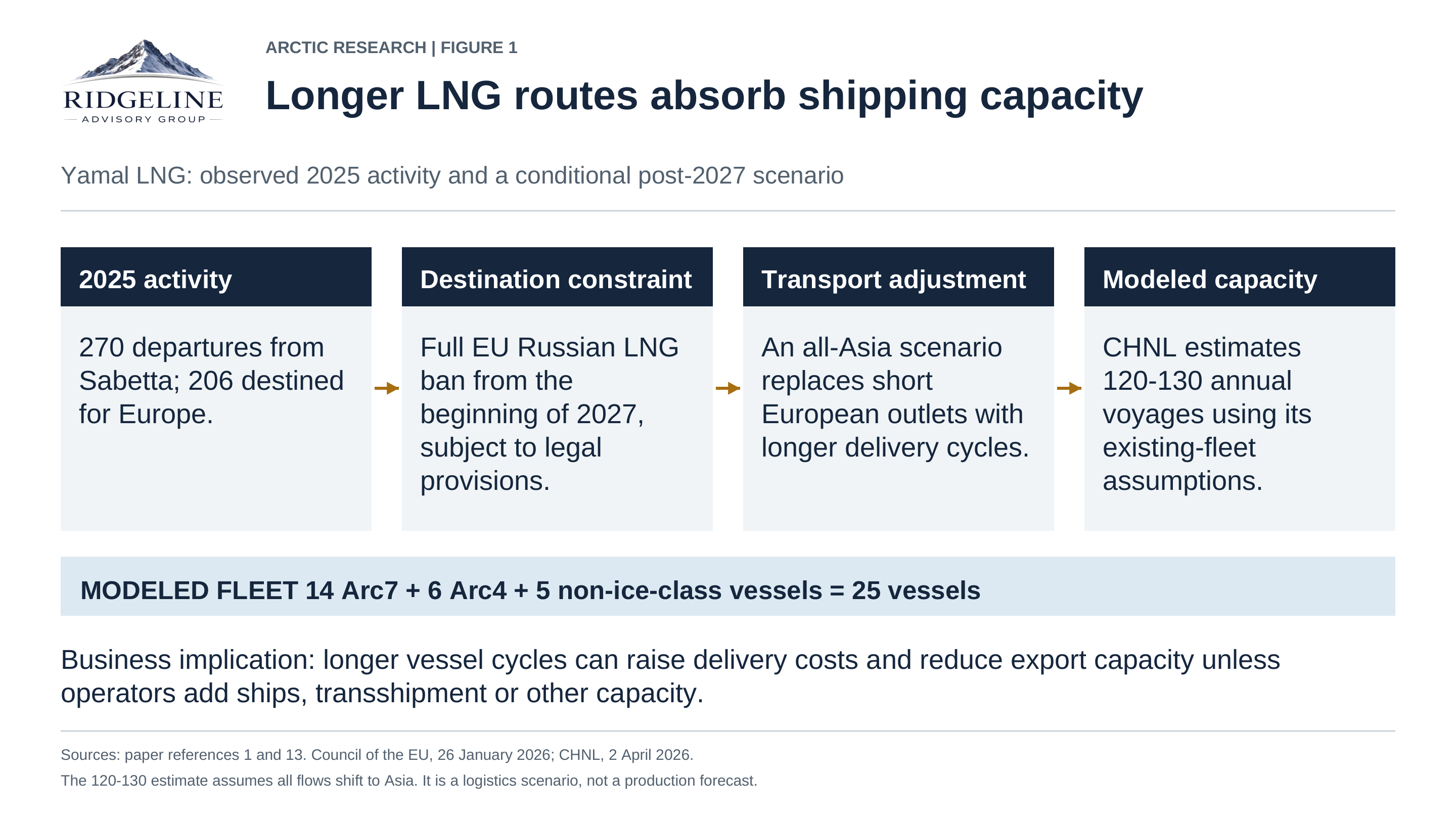
The same policy creates a transport problem for Russian Arctic LNG. CHNL's vessel analysis records 270 departures from Yamal LNG's Sabetta terminal in 2025, with 206 directed to Europe. Fourteen Arc7 ice-class carriers performed 241 departures. In CHNL's simplified scenario, redirecting all flows to Asia reduces the existing fleet's annual delivery capacity to roughly 120 to 130 voyages. Longer routes and seasonal constraints drive the result. This is a model of logistics, not a forecast of production or an audited cargo total. 13
The causal chain is specific. Removing short European outlets forces a choice among longer delivery routes, additional ships, transshipment, storage, and lower shipments. Longer vessel cycles absorb capacity even if the number of ships stays unchanged. Additional transport costs or discounted sales can then shift some of the adjustment cost to the producer. Losing an outlet can damage a resource's economics without preventing extraction.
Figure 1. Longer LNG routes absorb shipping capacity. CHNL’s simplified all-Asia scenario uses 25 vessels, including 14 Arc7 vessels. Sources: paper references 1 and 13.
A third effect could strengthen the bargaining position of remaining buyers. If acceptable destinations are concentrated and the producer lacks economical delivery alternatives, those buyers can press on price or terms. China could benefit through that mechanism. We do not infer that it already controls Yamal's export decisions, nor that every displaced European cargo will reach China. Vessel availability, sanctions, payment arrangements, and alternative buyers can alter the outcome.
Europe faces its own tension. The new Arctic strategy maintains that oil, coal, and gas should remain in the ground, including in Arctic regions, while the current gas system depends on a major northern supplier. This is a tension between supply security during transition and the desired investment trajectory. This doesn't mean Europe must abandon either objective. Lower demand can reduce the conflict; a long-lived project premised on continued high demand bears the risk if that reduction occurs. 9
Energy-intensive businesses should separate physical coverage from replacement costs. A company with no Russian contract can still face higher costs if European buyers compete for the same cargoes elsewhere. Producers and infrastructure investors need a different test: the investment must survive changes in destination, transport cycle and customer demand. A forecast of stable gas demand alone misses those exposures.
Shipping growth is real and concentrated
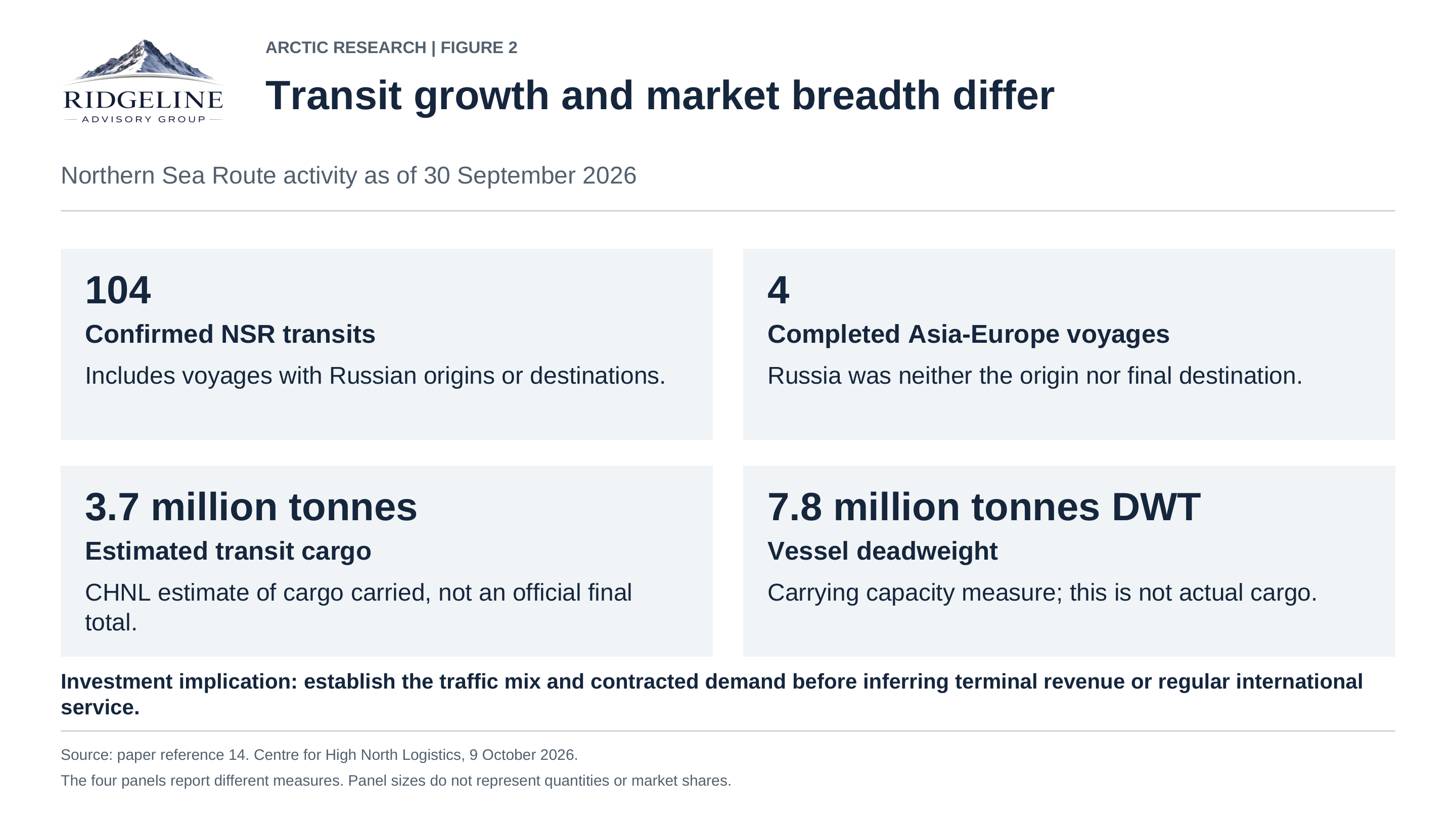
The Northern Sea Route is carrying more transit activity, but its growth doesn't yet establish a general substitute for established Asia-Europe services. CHNL identified 104 confirmed transits by 30 September 2026, exceeding 103 in the full 2025 season. Only four were completed Asia-Europe voyages with Russia at neither end, compared with one in 2025. Much westbound bulk traffic involved repositioning. These distinctions matter to port and vessel demand. 14
CHNL estimated 3.7 million tonnes of transit cargo by the September cutoff. Its separate 7.8 million tonnes of deadweight measures vessel carrying capacity, not actual cargo. Neither number should be confused with all shipping within the Russian Arctic. A resource voyage starting inside the route and an end-to-end transit answer different commercial questions. A larger vessel passing through also doesn't prove that it carried a full load. 14
Figure 2. Northern Sea Route traffic as of 30 September 2026. Voyage counts, estimated cargo and vessel deadweight measure different things. Source: paper reference 14.
The investment implication follows from the traffic mix. A terminal serving committed resource exports can have a stronger revenue case than one depending on large volumes of discretionary international transit. Conversely, a successful seasonal service can earn a return without becoming a year-round trunk route. The error is to require one model to justify the other.
A shorter voyage can reduce sea time, but the customer's total cost also includes vessel requirements, insurance, inventory, and schedule recovery. Fewer days at sea can coexist with more stock held against uncertain arrival. For a manufacturer, one missed delivery can outweigh several cheaper voyages if the cargo interrupts production. Bulk commodities with storage flexibility face a different tradeoff from tightly scheduled component flows.
Climate change doesn't remove this operating problem. The IPCC's polar assessment links greater route accessibility with persistent navigation challenges, including mobile ice. It also identifies infrastructure risks from changing physical conditions. Less average ice can open a route while leaving uncertainty about the conditions encountered on the particular voyage. On land, thaw can impose costs on the facilities that make a marine route commercially accessible. 15
The strongest case against our caution is the increase in completed international services. This shows the route can work for specific voyages. If repeat customers obtain acceptable performance, the market can deepen through accumulated experience and better services. We would revise our view as repeat operations establish schedule performance and customer economics. A rising transit count alone doesn't provide that evidence.
For logistics investors, the disciplined position is to finance the traffic that can be contracted and served. For shippers, evaluate an executable seasonal offer against the cost and disruption exposure of the cargo. We believe resource logistics has the stronger demonstrated demand base today; international transit remains an emerging segment whose commercial breadth has yet to be established.
Tanbreez shows how supply rights can precede production
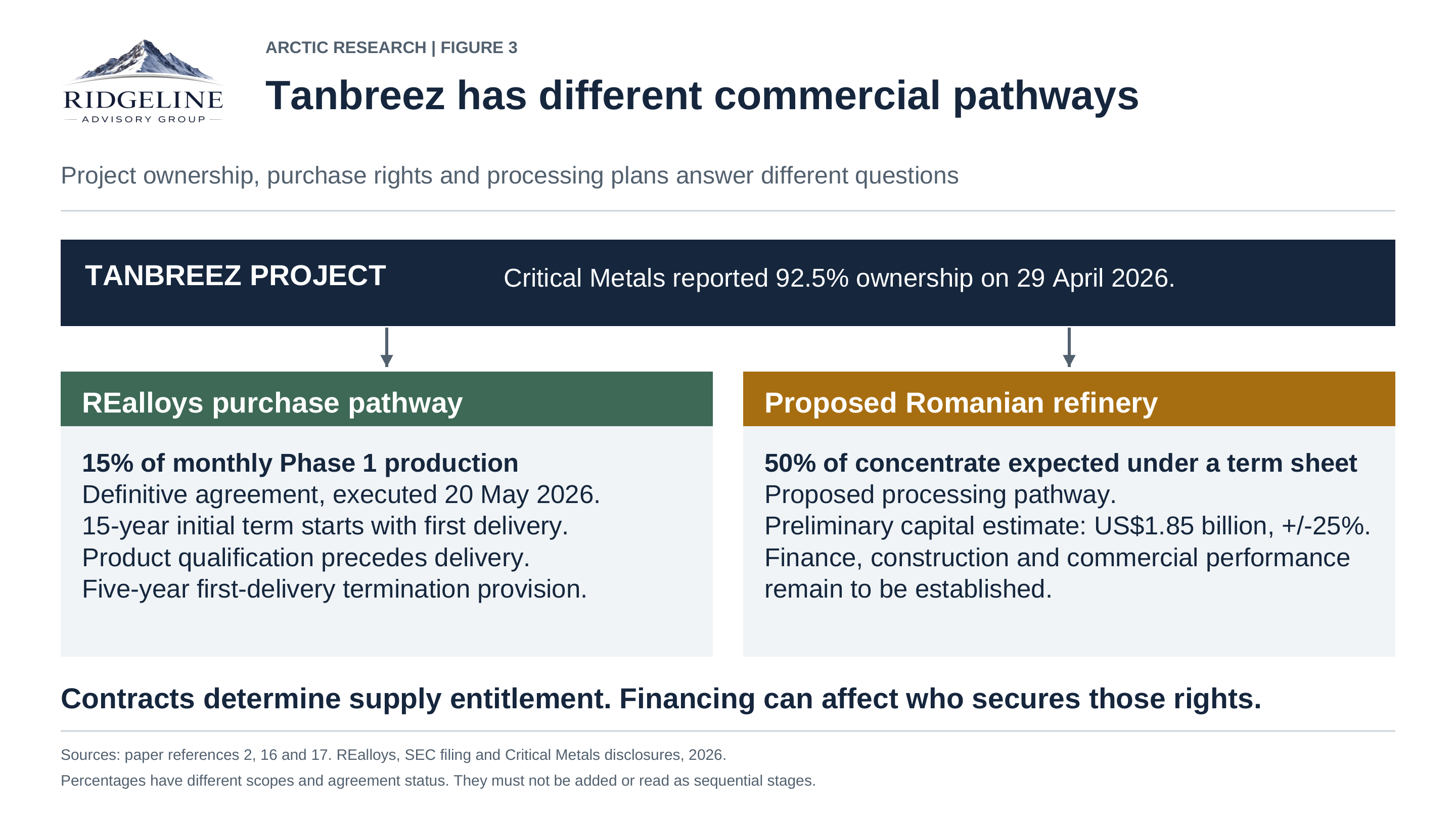
Tanbreez illustrates why a mineral deposit's location cannot establish a customer's future supply security. Critical Metals reported increasing its ownership from 42% to 92.5% on 29 April 2026. That transaction changed control of the project. A separate agreement determined who could purchase part of its prospective output. Ownership and supply entitlement answer different questions. 16
REalloys announced a definitive agreement executed on 20 May for 15% of Tanbreez's monthly Phase 1 production, subject to delivery variance. The initial 15-year term begins with first commercial delivery. The agreement requires product specifications and buyer qualification before delivery and allows termination if the first commercial delivery has not occurred within five years. Some pricing parameters require finalization. These provisions create a conditional claim on future material and explicitly protect against indefinite waiting. 2
A second pathway points toward Europe. Critical Metals' September disclosure describes a proposed Romanian joint-venture refinery expected to receive 50% of Tanbreez concentrate under an existing term sheet. Its study gives a preliminary capital estimate of US$1.85 billion (±25 %) and reports a laboratory dissolution result above 99%. A term sheet, preliminary estimate, and laboratory result do not establish a financed operating refinery or an accepted customer product. The figures are company disclosures. 17
Figure 3. Tanbreez ownership and commercial pathways. The disclosed percentages use different scopes and agreement status. Sources: paper references 2, 16 and 17.
The first strategic effect is that customers can negotiate for future production before the mine delivers. Second, those commitments can support the sponsor's financing case while obliging buyers to accept timing and performance exposure. The third is competition over the processing stage: locating extraction outside China improves geographic diversity, but finished supply still depends on separation, conversion, and customer acceptance.
The strongest optimistic interpretation is that offtake and processing development are precisely how a new supply chain gets built. That is correct. Their existence should improve the assessment from an unallocated deposit to a project with developing commercial pathways. It should not advance the assessment all the way to a qualified alternative source. The buyer's supply deadline remains decisive.
European manufacturers therefore cannot treat Greenland's partnership with the EU as a reservation of output. They need an enforceable route from material allocation to the product their plant accepts. For investors, the more revealing question is which participant finances each missing stage and receives rights in return. The geopolitical contest becomes visible in those terms.
Decisions turn on which alternatives can arrive in time
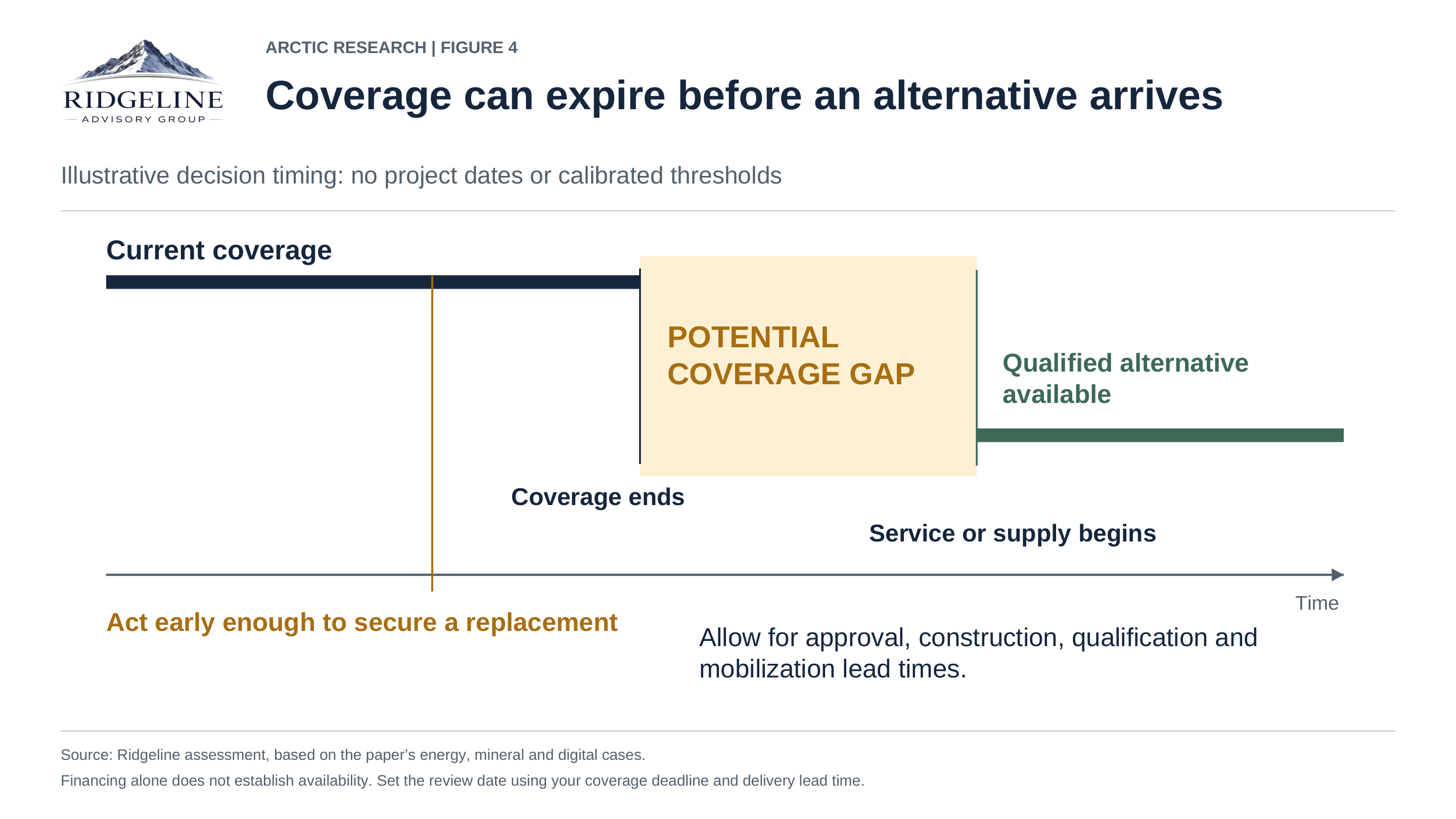
The cases point to a common business problem: a nominal alternative can exist without being available by the date the company needs it. An Arctic mine may become a future supplier while current coverage expires first. A cable project can improve long-term network choice while leaving today's recovery plan unchanged. A new gas destination can be legally available while the vessel fleet cannot support the same export rate.
Figure 4. A potential gap between expiring coverage and an available alternative. Illustrative timing; no project-specific dates. Source: Ridgeline assessment.
For digital infrastructure, that timing problem deserves particular attention. Polar Connect Step 2 funds 36 months of route, resilience and repair preparation. Its disclosed partners include the Swedish Research Council, NORDUnet, GlobalConnect, the Swedish Polar Research Secretariat and CSC, with GÉANT associated. The composition joins research and network capabilities, but the grant doesn't establish an operating intercontinental service. 10
A new physical route can reduce exposure to an existing corridor. Its commercial resilience value still depends on independent landing facilities, power, onward connections and restoration arrangements. The further effect is contractual: customers may pay for protected service while the operator bears the cost of reserving repair access. If protection is sold without sufficient restoration capacity, the promise can fail precisely when demand peaks. This is a scenario to test in the service design, not a finding about Polar Connect's eventual network.
Ridgeline Vantage translates developments into reviews of specific commitments. The conditions below are tied to the cases in this paper. They are review conditions, not calibrated early-warning thresholds or instructions to trade. The relevant executive response depends on the company's exposure and the alternatives still available.
Observation
Exposed decision
Reason to act
Russian LNG prohibition reaches full application in 2027
Gas coverage and replacement procurement
A legal destination change can alter price and shipping capacity
A mineral delivery or qualification date passes the buyer’s coverage deadline
Supplier substitution and advance funding
A future source cannot cover the intervening shortfall
A cable reaches financed construction and a contracted service date
Network procurement and capital allocation
The alternative advances from preparation toward deliverable service
A named military requirement becomes a funded award
Capacity reservation and supplier investment
A policy priority becomes attributable commercial demand
The opposite outcome must remain in view. Better coordination, completed projects and additional capacity can reduce security premiums and improve customer choice. Suppliers investing on a permanent-scarcity thesis could then face lower margins. A company should protect the option to benefit from that outcome while also insuring against disruption.
The investment conclusion
We judge that the Arctic's near-term business importance lies in the interaction between systems already operating and the rights now being negotiated around them. NATO's command changes affect security coordination. Europe's gas policy changes the outlets available to Russian Arctic producers. Tanbreez's agreements begin to allocate prospective material across commercial pathways. Cable grants shape future connectivity without yet replacing current service. These developments run on different clocks.
Boards must separate strategic relevance from an investable proposition. A strategic asset can attract public support and still produce a weak return if its delivery chain is incomplete or its customers retain most of the bargaining power. A less prominent service business can capture value by solving a specific constraint, such as integration, qualification, or contracted restoration. Location creates the opportunity; terms and performance decide who earns it.
Our confidence is high in the documented status distinctions: an operating command structure, an adopted gas phaseout, a definitive conditional offtake agreement, and funded cable preparation are different kinds of evidence. Confidence is moderate in the commercial mechanisms we infer from them. The magnitude of returns, delivery delays, and buyer bargaining gains requires project-level cost and contract data that public sources do not supply.
The strongest attack on our conclusion is that it places too much weight on constraints during a period when governments can spend to remove them. The NATO changes support that challenge. So do grants intended to resolve engineering uncertainty. Our response is to make the thesis revisable: delivery rights matter most while alternatives remain scarce or slow. When new capacity enters service, the analysis must shift toward utilization, operating cost, and competition.
The greater analytical error would be to treat every development as evidence of the same Arctic race. A legal restriction, a purchase agreement, and a successful voyage transmit risk through different mechanisms. Clients should identify which mechanism affects their cash flow, which agreement governs it, and the last date they can change course. That is the basis for deciding where to commit, where to wait, and what to secure first.
Analytical basis and limits
Ridgeline Vantage links conditions through operating dependencies to business decisions and identifies developments that warrant review. We tested competing explanations and traced second and third effects only where the initiating condition was stated. Prospective consequences are Ridgeline judgments, not reported outcomes. We assign no numerical scenario probabilities and make no Arctic-wide estimate of investment returns.
The evidence cutoff is 22 October 2026. Official documents establish policy, legal text, or institutional status; they don't prove commercial performance. Issuer and project disclosures establish what sponsors report, with their stated conditions. CHNL provides observed vessel activity and separately identified estimates. We have retained those differences throughout. The defense agreement's entry into force remains unverified in this assessment, and is not assumed in the investment conclusions.
Discuss the investment implications
Which supply right, operating dependency or delivery deadline could change your investment case? Contact Ridgeline to discuss the findings in the context of your portfolio or a planned investment.
DECISION WINDOW
Before the company gives up a current supply or service option, or commits capital whose value depends on an alternative arriving in time.
CONFIDENCE
High in documented project and policy status; moderate in the inferred commercial mechanisms. Return magnitude and delivery timing require project-level evidence.
WATCH NEXT
Russian LNG prohibition reaches full application in 2027, subject to the regulation’s provisions.
A mineral delivery or qualification milestone slips beyond the buyer’s supply-coverage deadline.
A cable reaches financed construction and a contracted service date.
A named military requirement becomes a funded supplier award.
EVIDENCE BASE
Numbered references support the factual claims. Links open the source documents. Assessment date 22 October 2026.
1 Council of the European Union. Russian gas imports Council gives final greenlight to a stepwise ban. 26 January 2026. Formal adoption; transitional rules and full application dates. Read source
2 REalloys. Definitive long term rare earth offtake agreement with Critical Metals. 21 May 2026. Buyer disclosure; 15% Phase 1 allocation, qualification and termination conditions. Read source
3 European Commission. Greenland partnership and key initiatives. Current country programme. €200 million package and €54.7 million Tusass Connect allocation; separate scopes. Read source
4 NATO. Arctic security. Updated 24 July 2026. Norfolk boundaries, Arctic Sentry and Bodø command arrangements. Read source
5 U.S. Department of Defense. 2024 Arctic Strategy. July 2024. Historical strategy; Kola Peninsula and Northern Fleet geography. Read source
6 State Council of China. China’s Arctic Policy. 26 January 2018. Historical official position; not a current operations inventory. Read source
7 Denmark Greenland and United States. Agreement amending the Greenland defense arrangements. 22 September 2026. Articles IV, VII, X and XII. Signed text; entry into force not verified. Read source
8 Inatsisartut. Proposal concerning the defense agreement. EM2026 249, 12 October 2026. Parliamentary proposal; not evidence of diplomatic notification. Read source
9 European Commission and High Representative. Europe’s Northern Neighbourhood A New Strategy for the Arctic. JOIN(2026) 100 final, 20 October 2026. Sections 2.1, 4.1 and 4.2; policy proposals and commitments. Read source
10 Polar Connect. Step 2 project kickoff. Project disclosure. €4.97 million EU contribution, €9.94 million total budget, 36-month preparation programme. Read source
11 European Commission Directorate General for Energy. Norway. 2025 import shares. Share of all EU gas imports; not a measure of Arctic production. Read source
12 ACER. EU LNG imports hit record high in 2025. 13 May 2026. LNG monitoring findings; U.S. shares use LNG imports and total gas demand respectively. Read source
13 Centre for High North Logistics. Yamal LNG export dynamics and post 2027 logistical capabilities. 2 April 2026. Vessel analysis and simplified scenario; excludes several operating delays. Read source
14 Centre for High North Logistics. Overview of NSR Transit Voyages as of September 30 2026. 9 October 2026. Confirmed voyages distinguished from estimated cargo and potential season outcomes. Read source
15 IPCC. Polar Regions. AR6 Working Group II, Cross Chapter Paper 6, 2022. Physical risks and shipping accessibility. Read source
16 Critical Metals. Tanbreez acquisition note. SEC filing, financial year ended 30 June 2026. Reported ownership transaction. Read source
17 Critical Metals. Tanbreez results and proposed refinery study. 16 September 2026. Issuer disclosure; term sheet, laboratory results and preliminary capital estimate. Read source